Wednesday, March 1, 2017

Triggering Lightbulb Moments


One of the most exciting parts of being an educator is seeing a "lightbulb moment" flash across a learner's face; it's that moment of sudden understanding, realization, or inspiration that you can see sparkling in the learner's eyes.  Our dedicated Pleasantdale staff members strive day in and day out to provide students with opportunities for these moments in school.  Active, engaging, and collaborative learning activities tend to yield such moments, making educators revel in the amazing potential we have to inspire our students.

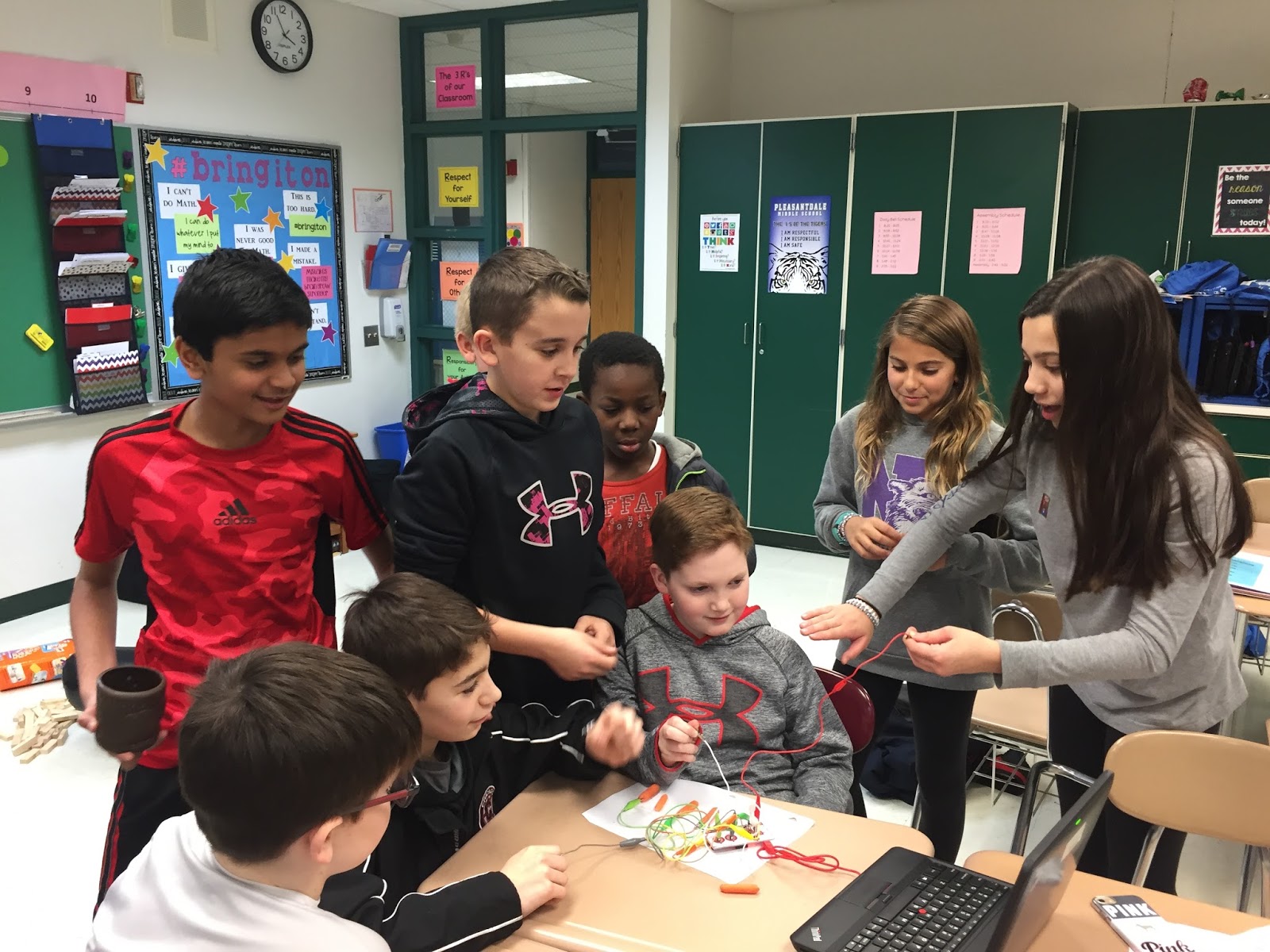
Students make a carrot keyboard in 3M Club.
However, we know these lightbulb moments are not confined within the walls of our schools.  Quite the opposite, in fact.  Rich learning occurs on a regular basis outside the classroom setting as learners explore new interests, meet new people, and encounter new situations.  District 107's goal is "to create a community of inspired learners."  This goal is not restricted to 8:20 AM - 3:22 PM, nor to mid-August through early June.  We want to trigger these lightbulb moments before school, after school, and all year round.  This is why we encourage students to take part in our many before and after-school clubs and athletics.  Likewise, we provide community resources for parents/guardians to help them continue to learn about interacting with their child, and we provide professional development to our staff members to help them further their learning as well.

As we continuously look to provide our students with educational opportunities outside of school, we are most excited about the revisions we have made to this year's Summer Academy (aka "summer school").  Although we are a small school district, we felt the absence of exciting enrichment classes in our Summer Academy program was a deficit area deserving attention.  After looking at other districts' summer school programs and talking to our dedicated Pleasantdale staff members about their own passions, we were able to create a Summer Academy program which includes a rich offering of enrichment classes for students currently in grades PreK - 7.

Students can explore their interests in crafting, sewing, reading Rebecca Caudill books, and creative writing through this summer's enrichment course options.  Classes like cooking, woodworking, coding, and photography may trigger new passions!  These exciting courses and more are available in the Summer Academy program book, which is also posted on our district and school website.  Registration for these Summer Academy enrichment classes is open now through March 24 (spring break), and we hope to have many of our students participate!

As this blog post points out, the opportunities for learning nowadays are limitless if we take the initiative to pursue our interests and passions.  It is time to "start learning from [our] own mistakes, adventures, achievements, and bold actions."  Let's give our learners more opportunities to engage in experiences that will trigger lightbulb moments!
What: Pleasantdale District 107 Summer Academy
Who: Pleasantdale 107 students currently in grades PreK - 7
Where: all classes held at Pleasantdale Middle School
When:  June 12 - July 7 (no class July 3 or 4 in observance of Independence Day); courses offered between 8:30 - 11:45 AM
Why: "To create a community of inspired learners"... Let's trigger more lightbulb moments!

Thursday, February 23, 2017

Our Greatest Asset: Our People!

"In the long run, your human capital is your main base of competition.  Your leading indicator of where you're going to be 20 years from now is how well you're doing in your education system."  —Bill Gates


Over the past few weeks, the District 107 administrator blogs have focused on our Future Planning process, highlighting exciting plans in the areas of Building Learning Capacity and Building Learning Environments.  Our third goal area of Building Human Capital is another critical piece of our plan.  The Future Planning Committee determined our goal in this area is to "Ensure PSD 107 is recruiting, hiring and retaining high-level professionals that engage in collaborative professional development and are committed to learning and implementing innovative strategies focused on improved student learning."

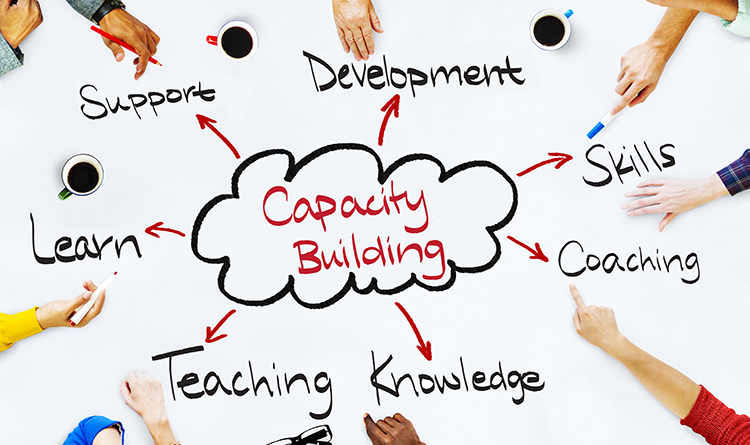
In the Bill Gates quote above, he begins to articulate why building human capital is so crucial.  Continuous learning is pivotal to capacity building.  In Michael Fullan's book The Principal: Three Keys to Maximizing Impact (2014) he states that, "humans are fundamentally motivated by two factors: doing things that are intrinsically meaningful to themselves and working with others—peers for example—in accomplishing worthwhile goals never before reached" (p. 7).  District 107 is committed to building the capacity of our staff members by providing rich opportunities for professional development based on teachers' needs and interests.  Likewise, it is important for us to build collaborative time into professional development for staff members so they are able to do this meaningful work with others who our common mission, "to create a community of inspired learners."

PMS math teachers collaborate
 Research shows that when teachers are provided with well-designed, sustained professional development, which includes time for collaborative conversations and on-going support, student learning improves.  Currently, our staff members have been receiving on-going professional development related to NWEA MAP testing and how it can inform instructional practices, as well as Schoology the Learning Management System (LMS) we adopted this year.  Math teachers have been engaging in professional development as a part of the Metro Chicago Math Initiative, and science teachers have been working diligently with a consultant to revamp science units in light of the new Next Generation Science Standards (NGSS).

As we look to the future of Pleasantdale professional development, the district is committed to creating a robust professional development plan aligned with best practices given teacher feedback on their passions and needs.  It is exciting to think of the growth ahead for our staff!
PES teachers collaborate


Thursday, February 16, 2017

Building Our Learning Environment

If you have not seen me in person recently, you may not be aware that my husband and I are expecting our first child, due to arrive at the end of April!  It has been so exciting to see ultrasound photos, hear the baby's heart beat, and share our joy with our family and friends as we anticipate this life-changing event.  As a part of our preparations, we are also spending time decorating a nursery for the baby.  We have a 10 ft x 12 ft room to work with, plenty of space for an infant, but we have still had numerous conversations about how we can be prepare the space for our new baby.  What colors will be calming and aesthetically pleasing?  What kind of furniture will be functional yet comfortable?  And will the furniture allow for enough flexibility to move the room into different configurations as the child grows and his/her needs change?

In my last few blog posts, I explained how our District 107 Future Planning Committee has honed in on three goal areas on which to focus over the course of the next five years: Building Learning Capacity, Building Learning Environments, and Building Human Capital.  While designing our 120 square foot nursery is nowhere near as challenging or as critical of a task as designing the learning environments in our schools, many of the questions my husband and I have asked ourselves about the nursery are helpful starting points for our conversations about building the learning environments in Pleasantdale schools.  What kind of furniture will be functional yet comfortable for learners (staff, students, community members)?  And will the furniture allow for enough flexibility to move the room into different configurations as the learners grow and their needs change over time?

The Future Planning Committee decided our District's goal is to "provide flexible learning environments that promote purposeful collaboration and a balanced educational approach to create inspired 21st century learners."  This means we will dig into research related to collaborative spaces and furniture for teachers and students and develop responsible plans for replacing and renewing technology for these spaces so staff and students alike are able to extend their learning beyond the walls of the classroom.  Articles like this one from EdTech Magazine explain how some schools have begun to transform their learning spaces while also creating easy opportunities for learners to connect and collaborate with others around the world.  As stated in the article, "What we're moving toward is flexible learning environments...It's not just the physical space -- it's the mindset, the skills intended to be taught and the physical environment, all combined."

There is a lot of truth in this statement.  Our goal of Building Learning Environments goes beyond simply building the physical learning environment; it also extends to the culture of learning created within our schools.  In one of my January blog posts, I wrote about the sound of future-ready learning spaces.  The points I make begin to speak to the type of culture we hope to create in our learning environments, which also ties into our portrait of a Pleasantdale Graduate.  Everything we will be doing with our learning spaces will be done with the aim to create students who are strong communicators and problem-solvers, who are confident individuals and global citizens.  It is our goal to create flexible learning spaces that will enable us to cultivate these characteristics in our Pleasantdale community of learners.

Thursday, February 9, 2017

"Sticky" Learning: Building Learning Capacity


As I mentioned in my blog post last week, the District 107 Future Planning Committee spent a significant amount of time and effort shaping our district's new mission statement and portrait of a graduate.  These serve as the driving forces behind the action plan guiding our district over the course of the next five years.  With the mission and portrait of a graduate in mind, the Future Planning Committee was able to craft goals in three distinct areas: Building Learning Capacity, Building Learning Environments, and Building Human Capital.  This week, I want to delve more deeply into the first goal area of Building Learning Capacity.

I remember seeing a powerful quote on a Lululemon Athletica bag a few years ago which said, "The world is changing at such a rapid rate that waiting to implement changes will leave you two steps behind.  Do it now, do it now, do it now!"  This quote has really stuck with me, and I think it perfectly encompasses the way the Future Planning Committee looked at the goal area of Building Learning Capacity.  
Fifth graders Skype with
scientists in Antarctica.

Learning capacity refers to the way a person is able to process, consume, and internalize new information.  To the Future Planning Committee, this meant we had to look at how meaningful, "sticky" learning occurs in this day and age.  In the book my colleague Jamie Diamond and I (2014) wrote Literacy Lessons for a Digital World, we acknowledge that "teachers are entrusted to prepare students for jobs that do not exist yet, so we must constantly consider the future of our students as we plan our lessons and learning activities" (p. 8).  This means the way teachers look at shaping their students' learning experiences must transform since the future for which we are preparing our children is unknown.  However, given our new district mission "to create a community of inspired learners," we are not just talking about reshaping learning for students but also for staff and community members.  Will Richardson (2015) insists in his book From Master Teacher to Master Learner that "teachers must be learners first in the classroom, able to model clearly what it means to work perpetually on a learning curve" (p. 10).  Therefore, we had to consider how both the adults and children in the District 107 community can maximize their learning potential.


Students in the 3M club used
MakeyMakey to create a
vegetable piano!
The committee ultimately came up with the goal that "Pleasantdale leaders and learners will cultivate advancement of global competency and cultural awareness through innovative learning experiences."  The committee's rationale in creating this goal was that it will allow our students to be open to new opportunities and will promote adaptive, innovative, empathetic, articulate, and respectful citizenship.
 This means we will be looking to explore pilot opportunities related to new learning experiences, which may include STEAM, Maker Spaces, interdisciplinary units, and implementing Genius Hour.  We want to continue to foster, promote, and instill a growth mindset within our staff, students, and community members, and we will investigate a variety of strategies and resources related to differentiating learning, assessing student learning, and the effective integration of educational technology.

The creation of this plan is just the beginning as we think about building the learning capacity of our Pleasantdale community, and we are excited about what lies ahead for us!


Thursday, February 2, 2017

Planning for the Future


Goal setting is an important component of success, regardless of what field you work in or how old you are.  As Earl Nightengale said, "People with goals succeed because they know where they are going."  This recent article from Forbes, "5 Reasons Why Goal Setting Will Improve Your Focus" gives a brief overview of why goal setting can be so powerful.  According to the article, goals trigger behavior, guide your focus, sustain momentum, align your focus, and promote self-efficacy.  For many of these same reasons, teachers regularly talk to their students about setting goals for themselves related to academics, behaviors, and peer relationships.

As a district, Pleasantdale strives to continuously improve as we work together to provide our students with an optimal educational experience.  Because of this, District 107 engages in goal setting as well.  Our Future Planning process was the best way to involve as many stakeholders as possible in our goal setting.  Parents, community members, teachers, students, and administrators came together to collaboratively create a plan for our schools that will sustain us over the next five years.  The three focus areas of the goals created by the committee relate to Building Human Capital, Building Learning Capacity, and Building Learning Spaces.  However before we could dig into the specifics of what our goals were going to be, it was important to have a claer mission for our District to guide us.  

After studying a variety of powerful mission statements and brainstorming our values of what transformative "sticky" learning looks like, the committee created the new and improved mission for District 107:

To create a community of inspired learners.


Once this mission was established, we were able to use this unified vision to begin establishing our goals.  The next step in the process was to create a portrait of a Pleasantdale graduate.  Given our mission, we asked ourselves the key characteristics we hope all our students possess by the time they walk across the stage at the eighth-gradee graduation ceremony.  After much collaboration and discussion, the committee agreed we hope our students are successful communicators, problem solvers, global citizens, and individuals.

With both a mission statement and our portrait of a Pleasantdale graduate in place, the Future Planning Committee then had the task of fleshing out specific goals for the three areas of Building Human Capital, Building Learning Capacity, and Building Learning Spaces.  Over the next three weeks, our administrative blog posts will delve deeper into each of these areas as we celebrate the goals that are focusing our District's journey throughout the next five years.


Thursday, January 26, 2017

The Sound of Future-Ready Learning Spaces

From the Edutopia post "Visualizing 21st Century Classroom Design"
As I mentioned in my post last week, the physical learning spaces our students enjoy today are transforming as we embrace the shifts in the education our children need to be successful.  In Mr. Glimco's blog post this week, he talks more about the future of our learning spaces as discussed and envisioned by our District 107 Future Planning Committee.  Articles like "Why The 21st Century Classroom May Remind You of a Starbucks" and "21st Century Education for a 21st Century Economy" helped shape the vision for what we want our future classrooms to look like.  Flexible learning spaces with room for collaboration and innovative technology are at the forefront of this vision.  But in addition to what a classroom looks like, to me it is equally important to think about what a future-ready classroom sounds like.

What will our future-ready classrooms sound like?


Loud!
Students should be collaborating, tinkering, and actively "doing" on a regular basis.  This requires oral communication between students, as well as regular guidance from the teacher.  This doesn't mean the teacher is telling students what to do; rather the teacher is asking strategic questions to get students thinking at higher levels and is providing specific feedback when students veer off-track.  Students should also be engaging in similar types of discourse with one another as they analyze and critique the reasoning of their peers during problem-solving processes.  When students are building, creating, and experimenting, it is important to hear the sound of materials being assembled and disassembled, the sounds of videos being recorded and revised, and the sounds of hard work.

Inquisitive!
As educators, it is our goal to promote autonomous problem-solvers and critical thinkers.  To do this,  teachers must encourage students to question their own thinking and the thinking of others to help them understand how to applying their learning to novel situations.  Teachers should not be the only ones asking the question; students should be asking questions too!  Asking good, thoughtful questions forces cognitive dissonance, which leads to the acquisition of new information or a new way of thinking.  A blog post I wrote back in October, 2015, discusses how students can use technology meaningfully to engage in higher level thinking tasks, which can include investigating the answers to their own juicy questions.

Reflective!
Reflection is another important component of a future-ready classroom.  While teachers certainly coach, question, and support students through specific feedback, it is important that students are also thinking critically about their experiences themselves.  Asking themselves questions like "What was successful and why?" and "What didn't work, and what do I think went wrong?" will help students learn from their experiences to improve their thinking in the future.  Thomas Edison epitomized this reflective nature when he said, "I have not failed.  I've just discovered ten thousand ways that don't work."

Supportive!
In a future-ready classroom, risk-taking is embraced and encouraged.  We know from Carol Dweck's research on the Growth Mindset that failure provides great learning opportunities.  Synapses fire in the brain when mistakes are made, which leads to learning.  The goal in a future-ready classroom is to provide students with a safe, supportive environment where failure is accepted and even encouraged since teachers know this is when the richest learning opportunities occur.  There are an abundance of books about failures detailing how such experiences have led to learning and great success.  It is important to remember that encouraging perseverance and patience throughout this process is what leads to the greatest growth after failure so learning can truly occur.


Thursday, January 19, 2017

The Evolution of Our Learning Spaces

I graduated from middle school in 1998, and while that year is before our Pleasantdale Middle School students were even born, I know I am still pretty young.  One would think that my educational experience would be pretty similar to that of our current students...but in actuality, that is not the case.  Clearly, the evolution of technology has dramatically changed the landscape of education today.  However, what may not be as glaringly obvious is the fact that the learning spaces, the physical environments in which the students learn, have transformed over the years as well.

Students work in pairs
in Mrs. Bubulka's class.
When I was in school, I always sat in an individual desk which was always arranged neatly in a row.  I remember vividly students getting in trouble for kicking the basket on the desk in front of them.  Nowadays, there are still occasions when students sit in rows (independent work is certainly still valued!), but more often than not, students are sitting with a partner or a small group in order to compare and contrast ideas and work collaboratively with one another.  This means students are seated around tables or at desks clustered into groups.
Students work at tables
in Mrs. Triggs's class.

Many of us remember the movie clip from Ferris Bueller's Day Off where the Ben Stein plays the epically boring economics teacher lecturing on the Hawley-Smoot Tariff Act.  Luckily for our students, lectures like these are a rarity nowadays.  Our students are encouraged to construct their own learning, and teachers take on the role of facilitators who ask strategic questions, probe deeper thinking, and provide students with opportunities to engage in critical thinking tasks.  Because much of the learning nowadays is student-centered, there is rarely a "front" of the classroom.  Sometimes students are facing the side of the room where content is projected on the Promethean board, while other times students do not have the need to "face" any direction in particular since the teacher as "sage on the stage" does not have a central role in lesson delivery.  This allows for more flexibility when teachers set up their classrooms since every nook and cranny has the potential to become a learning space.  In fact, the District 107 Future Planning Committee spent a significant amount of time discussing the future of learning spaces in our schools, and we are excited to share some of that work with you in the upcoming weeks.
A student works on his art
in the hallway at PMS.

Finally, and perhaps most importantly, we know that students learn best when they are comfortable in their environment.  This means providing students as many opportunities as possible to have a voice in how the room is arranged and providing them with some ownership in the classroom environment.  When I was in school, student work was hung on bulletin boards outside the classroom, but often times the classroom walls themselves were for store-bought posters.  While these posters may provide useful information, they did not give students a sense of ownership in their learning or in the classroom.  Now when we take a look in our classrooms, we see student work all around the room.  Often times the student work serve as anchors for future classroom discussions and points of reference.  Teachers may ask students, "Remember when..." while pointing to a student-created poster hanging on the wall.  This validates the students' learning and reinforces the classroom culture where high expectations for all students are valued.

As our world changes, so much education, and along with that the physical space our in which our children learn.  Stay tuned...next week we will be sharing the District 107 Future Planning Committee's vision for the continued evolution of learning spaces in our district!
Displaying student work in classrooms has become the norm.